
News
Introduction to PP Hollow Sheet Extruder
Jul 21, 2026
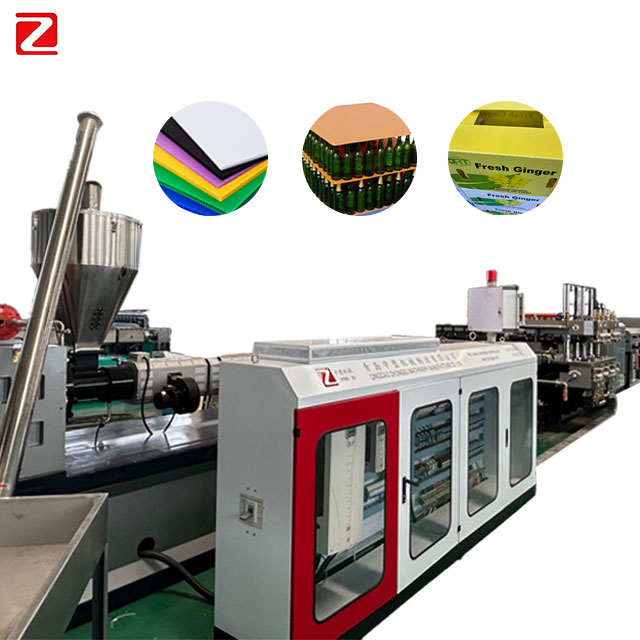
PP hollow board, also known as plastic hollow grid board or Coroplast, is a hollow plastic sheet made from polypropylene (PP) via extrusion molding. As the core equipment for producing this sheet, the PP hollow board extruder is widely used in packaging, building materials, advertising, logistics and other fields, and is a key device in the plastic processing industry. It is a complete extrusion production line, whose core components include an extrusion main machine, screen changer, mold, shaping and cooling system, traction device, cutting device and electrical control system. All parts work together to ensure continuous production. The extrusion main machine is the power core, with its screw adopting a gradual compression structure with a length-diameter ratio of 32:1~36:1. This design adapts to PP material characteristics, avoiding high-temperature degradation and ensuring uniform plasticization. The barrel is made of wear-resistant alloy and treated with surface nitriding; the heating and cooling system uses segmented temperature control, and the transmission system can adjust the rotation speed to control output. Most screen changers are hydraulic quick-change or 4-plate circulating types, enabling non-stop screen replacement. The replaceable filter screens are suitable for raw materials of different purities. The mold is made of high-quality alloy steel with a fine-tunable lip, capable of producing hollow boards with a thickness of 2-14mm and a width of 1220-2600mm to ensure molding quality. The shaping and cooling system includes a vacuum shaping table and a cooling water tank; some high-end equipment is equipped with an air cooling system to improve cooling efficiency. The traction device uses frequency conversion speed regulation, and the cutting device is mostly automatic to ensure neat sheets. The electrical control system adopts PLC control, equipped with a human-machine interface and fault alarm function, which is easy to operate and can reduce downtime.
The working process of the PP hollow board extruder consists of four core stages: raw material melting, extrusion molding, cooling and shaping, and traction cutting. PP particle raw materials (fillers and color masterbatches can be added) are put into the hopper and sent to the barrel of the extrusion main machine via automatic feeding. The screw extrudes and shears the raw materials, and the segmented heating melts them into a molten state. After being filtered by the screen changer, the molten material enters the mold to form a hollow slab. The slab is initially shaped by the vacuum shaping table and fully cooled by the cooling water tank, becoming a hollow board with stable dimensions. Finally, the traction device pulls it at a constant speed, the cutting device automatically cuts it to the set length, and the stacking device sorts and stacks the finished boards to complete production. The equipment has prominent advantages: First, it is efficient and energy-saving, saving 15%-20% energy compared with traditional equipment, with a single-unit output of 300-800kg/h, and non-stop screen changing further improves efficiency. Second, it has high molding quality and flexible specifications, capable of producing hollow boards of different sizes and colors to meet the needs of multiple fields. Third, it is easy to operate and maintain, with a modular design for convenient disassembly and assembly, and the fault alarm function reduces maintenance costs. Fourth, it has strong green adaptability, can use recycled materials, emits no toxic gases during production, waste materials are recyclable, and can be equipped with an exhaust gas treatment device as required.
Thanks to the excellent characteristics of PP hollow board, such as light weight, compression resistance and moisture resistance, the sheets produced by the extruder are widely used in packaging, building materials, advertising, logistics and other fields, and can also be used in agriculture, automobiles, electronics and other industries to make seedling trays, interior parts and more. With the development of the industry and the upgrading of market demand, the PP hollow board extruder is innovating towards high efficiency, energy saving and intelligence. In the future, it will improve output and reduce energy consumption by optimizing the screw and heating and cooling systems, introduce intelligent technology to realize full-automatic control and remote monitoring, and develop towards specialization and customization to adapt to the production of special sheets such as ultra-thick and ultra-thin ones. It will further improve environmental protection performance and promote the green and sustainable development of the industry. To sum up, as the core of PP hollow board production, this equipment occupies an important position in the plastic processing industry. Its performance improvement and application expansion will provide better material support for various industries.
Navigation
- PP Hollow Corrugated Sheet Machine
- PP Hollow Corrugated Sheet Extrusion Line | Reliable PP Honeycomb Board & Hollow Grid Panel Making Machine
- Advanced High-Efficiency WPC Profile Production Line Launched to Empower Green Building Material Manufacturing
- PVC Profile Extrusion Equipment Leads Industry Upgrade with Energy Efficiency and Intelligent Innovation
- Technological Upgrades of Hollow Building Formwork Equipment Drive Green and Efficient Transformation of Global Construction Industry
- Qingdao Zhongsu Machinery Supplies Customized 6m PE Waterproof Membrane Extrusion Line to India
Send Us A Message
Send Your Inquiry
We welcome your cooperation and we will develop with you.